Peer Review Process
Peer Review Process
JAST follows a double-blind peer-review process. All submissions undergo an initial editorial screening, followed by evaluation by at least two independent reviewers with relevant expertise. Editorial decisions are based on scientific quality, originality, methodological rigor, and relevance to the journal’s scope.
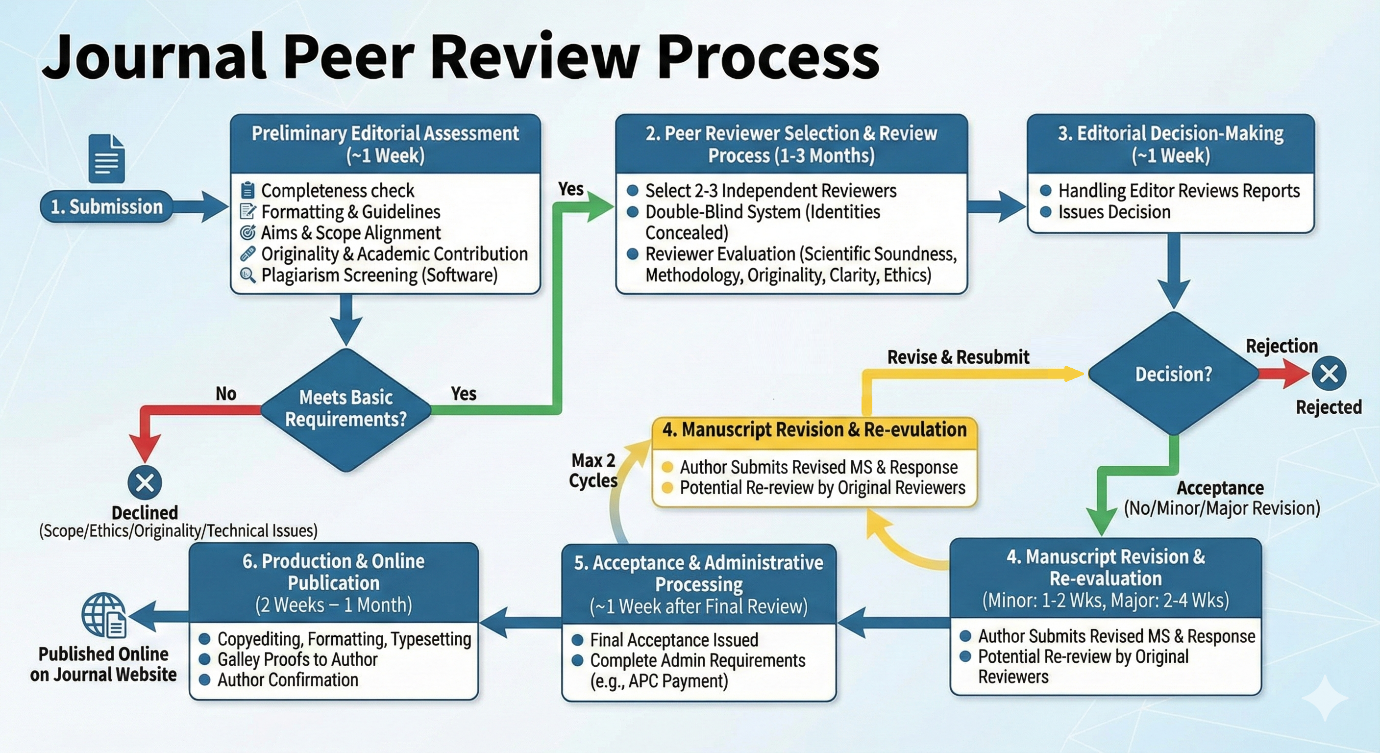
1. Submission and Preliminary Editorial Assessment
Following submission through the journal’s manuscript system, each manuscript undergoes a preliminary assessment by the editorial team. This initial evaluation generally requires around one week and focuses on determining whether the submission meets the journal’s basic requirements. At this stage, the editors examine the completeness of the submission, adherence to formatting and author guidelines, alignment with the journal’s aims and scope, and the level of originality and academic contribution. All manuscripts are screened for similarity using plagiarism-detection software prior to further consideration.
Based on this assessment, manuscripts may either be advanced to the peer-review stage or declined due to issues related to scope, ethical standards, originality, or technical quality.
2. Peer Reviewer Selection and Review Process
Manuscripts that successfully pass the initial editorial assessment are sent for peer review. Each manuscript is evaluated by at least two to three independent reviewers with relevant expertise in the subject area. The journal applies a double-blind peer-review system, whereby reviewer identities are concealed from authors and vice versa. A review round typically takes one to three months, depending on the complexity of the manuscript and reviewer availability.
Reviewers are asked to evaluate the manuscript’s scientific soundness, methodological quality, originality, clarity of presentation, and compliance with ethical and reporting standards. Their assessments form the foundation of subsequent editorial decisions.
3. Editorial Decision-Making
After all reviewer reports have been received, the handling editor reviews the recommendations and issues an editorial decision, usually within one week. Possible outcomes include acceptance without revision, acceptance subject to minor or major revisions, an invitation to revise and resubmit, or rejection. All decisions are communicated formally through the journal’s submission system. Direct contact between authors and reviewers is not permitted at any stage of the process.
4. Manuscript Revision and Re-evaluation
When revisions are requested, authors are expected to submit a revised version of the manuscript within the timeframe specified by the editor. Minor revisions are typically expected within one to two weeks, while major revisions may require two to four weeks. Authors must provide a detailed response explaining how each reviewer comment has been addressed.
Revised manuscripts may be returned to the original reviewers for further assessment. The journal generally limits the review process to a maximum of two review cycles before reaching a final decision.
5. Acceptance and Administrative Processing
Once the editorial team and reviewers are satisfied that the manuscript meets the journal’s quality and ethical standards, a final acceptance decision is issued. This stage usually occurs within approximately one week after the completion of the final review. Following acceptance, authors are required to complete any outstanding administrative requirements, including payment of the Article Processing Charge (APC) if available, in accordance with the journal’s publication policy.
6. Production and Online Publication
Accepted manuscripts proceed to the production phase, which includes professional copy-editing, formatting, and typesetting. Authors are provided with galley proofs for final review and approval. After author confirmation, the article is prepared for online publication. The production process typically takes two weeks to one month, after which the article is published on the journal’s official website.
Estimated Timeline
|
Stage |
Typical Duration |
Description |
|---|---|---|
|
Editorial Assessment |
~1 week |
Scope, formatting, originality, similarity check |
|
Peer Review (per round) |
~1–3 months |
Double-blind evaluation by expert reviewers |
|
Editorial Decision |
~1 week |
Decision based on reviewer feedback |
|
Author Revision |
~1–4 weeks |
Revision and response to reviewers |
|
Additional Review (if required) |
~1–3 months |
Assessment of revised manuscript |
|
Final Acceptance |
~1 week |
Editorial confirmation |